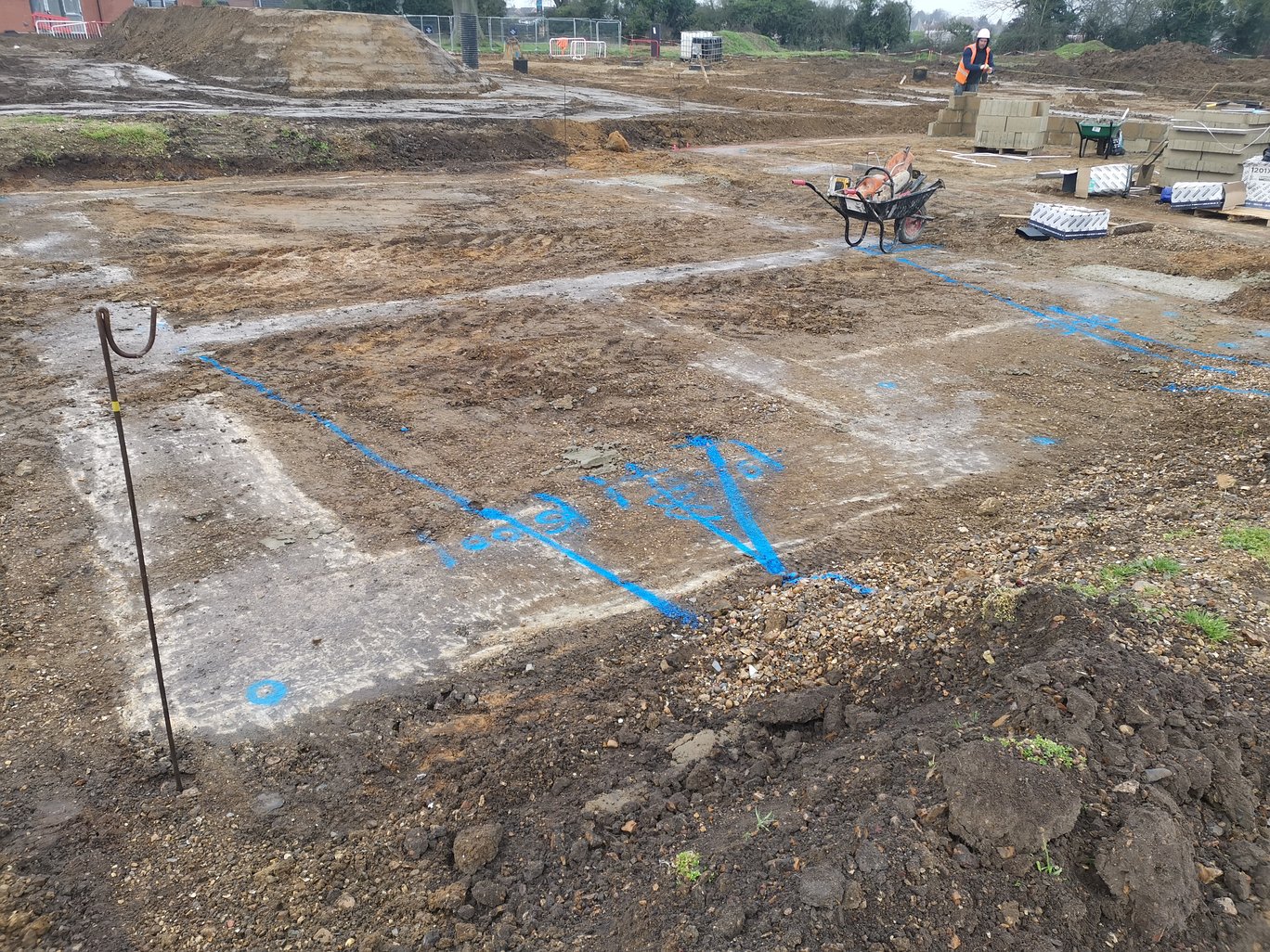
On most housing developments, the civil engineering design is largely complete before the contractor responsible for delivering it is engaged. This is the standard procurement sequence, and it works — provided the design has been developed with delivery in mind. Where it has not, the contractor inherits a design that is theoretically sound but practically difficult to build, and the consequences run through the programme. Buildability is the discipline of making sure design intent and delivery practicality are aligned at the point at which decisions are made, not after.
What buildability means in groundworks and civils
Buildability is the extent to which a design can be constructed efficiently, safely, and to programme using standard methods, plant, and materials. A buildable design is one that the contractor can deliver without resorting to unusual sequencing, bespoke temporary works, or non-standard plant. An unbuildable design — or a design with poor buildability — forces the contractor to work harder for the same outcome, increases the risk of error, and typically extends the programme.
In groundworks and civil engineering specifically, buildability concerns include access for plant and material delivery, sequencing of excavation against material disposal, drainage runs that can be installed without clashing with foundations or services, and roads and sewers detailing that aligns with adoption standards while remaining practical to construct.
Common buildability issues in housing schemes
On a typical housing development, buildability issues tend to cluster in a few predictable areas. Drainage runs designed without reference to the actual fall available across the site can produce gradient issues that emerge during construction. Roads and sewers detailing that meets highways adoption standards on paper can require sequence-of-work adjustments to deliver on a constrained site. Foundation designs that do not account for the actual ground conditions encountered — particularly on East Anglian sites with chalk, clay, or made ground variations — can require redesign mid-build.
None of these are catastrophic in isolation. Each one introduces a small amount of programme slip, a small amount of additional cost, and a small amount of management time spent resolving the issue. Across a full scheme, they accumulate.
Why early contractor engagement matters
Buildability is best addressed at design stage, before the design is frozen and the contract is awarded. This is why early contractor engagement — whether through pre-construction services, design-and-build procurement, or simply informal review of the developing design — produces better outcomes than late-stage contractor mobilisation. A contractor with delivery experience can identify buildability issues in a design and propose alternatives before they become embedded.
GCE’s position in the project lifecycle as the earliest entry point for the Globe Group means the business is often engaged at a stage where buildability input can still influence the design. On schemes where this engagement happens, the downstream packages — including scaffold under Globe Cambridge and roofing under Globe Roofing — also benefit from a more buildable design across the full scheme.
Practical buildability inputs from the groundworks contractor
Specific buildability inputs that GCE provides where engaged early include review of access strategy for plant and material delivery, assessment of muck-away and material reuse potential, identification of temporary works requirements, evaluation of drainage run sequencing against foundation programme, and review of roads and sewers detailing against the achievable construction sequence.
These inputs are not design changes for their own sake. They are practical refinements that align the design with the way the work will actually be carried out, reducing the risk of mid-build redesign or sequencing rework.
The commercial benefit
For developers and QSs, buildability input from the groundworks contractor at design stage produces measurable commercial benefits. Programme risk reduces because sequencing issues are identified before they become live problems on site. Cost certainty improves because the priced design reflects what will actually be built, not what was theoretically designed. Variations during delivery reduce because the design has been pressure-tested before contract award.
On a multi-phase development, these benefits compound. The buildability lessons learned on phase one can be applied to phase two design, producing a tighter and more efficient delivery as the scheme progresses.
CDM 2015 and buildability
Buildability also intersects with CDM 2015 obligations. The principal designer is required to consider how the design can be constructed safely. A design with poor buildability is, by definition, harder to construct safely — it requires non-standard methods, unusual sequencing, or bespoke temporary works, all of which introduce risk. Contractor input at design stage supports the principal designer’s CDM duties as well as the developer’s commercial interests.
Talk to GCE about your scheme
To discuss early-stage buildability input on your next development, contact GCE on 01223 890727 or email enquiries@theglobegroup.co.uk.