Engineering ensures you design and maintain structures that last, using robust design, high-quality materials and planned maintenance to safeguard your assets and public safety; you must mitigate risks like corrosion, fatigue and foundation failure through inspection, monitoring and adaptive repair strategies, and adopt sustainable practices shown in Why Structural Design Is Vital for Sustainable Civil … to secure long-term performance.
Design Principles for Longevity
You prioritise principles that extend service life: performance-based criteria, clear load paths and redundancy, material selection and protective detailing. Many projects set formal targets – typically a 50-year design life for buildings and 100 years for major bridges – and use Eurocodes and EN standards to translate those targets into cover depths, fatigue checks and inspection regimes, reducing lifecycle costs and failure risk.
Performance-based design, load paths, and redundancy
Performance-based design lets you specify acceptable outcomes – immediate occupancy, life safety or collapse prevention – rather than only prescriptive dimensions. Engineers use nonlinear analyses, pushover studies and dynamic modelling to verify load paths and the effect of element loss so alternative paths exist; incidents like the Ronan Point progressive collapse (1968) directly influenced modern UK robustness and redundancy requirements.
Serviceability, durability targets, and lifecycle thinking
You set serviceability limits (deflection, vibration, crack widths) alongside durability targets to control performance without excessive maintenance. Typical comfort deflection limits are around L/360 for floors, while durability uses exposure classes (XC, XD, XS) to select cover and concrete strength; for marine structures you may specify 50-75 mm cover and C40/50 concrete to meet a 100-year design life.
When you adopt lifecycle thinking, apply BS EN 1992-1-1 service-life prediction: modelling chloride ingress and carbonation lets you choose cover, concrete permeability (w/c <0.45) and cement type to delay corrosion initiation by decades. Inspections every 2-5 years for critical assets detect early deterioration, and targeted measures – epoxy-coated or stainless reinforcement in splash zones, increased cover, or cathodic protection – are often cost-effective, with initial premiums commonly repaid by reducing replacement or repair costs over a 50-100 year horizon.
Materials and Durability
You prioritise low‑permeability concrete (water-cement ratio <0.45) with supplementary cementitious materials like 50% GGBS where exposure demands reduced chloride ingress, and you specify corrosion‑resistant metals such as stainless steel 316 or duplex for marine projects. Service‑life targets commonly range from 50-120 years, so you combine material selection, protective coatings and detailing to minimise maintenance cycles and preserve structural performance under cyclic loading, freeze-thaw and aggressive chemical attack.
Selection of durable materials and protective systems
When choosing materials you refer to BS EN 206 and exposure classes (XC, XD, XS) to set concrete cover, admixture doses and coating systems; for example, coastal piers often use duplex stainless or cathodic protection with 60-80 mm cover adjustments. You favour galvanised or thermally sprayed zinc for secondary steel and specify manufacturer qualifications and warranty terms to ensure protective systems perform for the intended design life.
Testing, quality assurance, and corrosion mitigation
Testing regimes combine laboratory mix trials, chloride diffusion tests and site NDT such as ultrasonic pulse velocity, half‑cell potential mapping and pull‑off adhesion tests; you enforce ISO 9001‑aligned QA and factory production control to catch deviations early. Routine monitoring-concrete resistivity, corrosion rate sensors and visual inspections-lets you intervene before section loss exceeds serviceability limits.
For active corrosion control you deploy impressed current cathodic protection or sacrificial anodes depending on structure size; impressed systems can reduce corrosion rates by over 90% and extend life by decades when paired with remote condition monitoring. You design anodes, wiring and monitoring to BS EN guidance, and use periodic calibration and data review to validate performance against expected decay curves.
Construction Practices and Quality Control
You must enforce documented methods, hold points and third‑party checks so your project meets design intent; for example, concrete mixes typically target 28‑day strengths of 25-40 MPa and slump controls of 75-150 mm. Use progressive inspections and refer to resources such as The Role of a Structural Engineer in Building Strong and … to align structural detailing with on‑site practice and reduce rework. Strong quality control saves time and cost.
Site management, workmanship, and tolerances
You should implement daily quality checklists, trained supervisors and calibrated instruments so workmanship meets specified tolerances; typical alignment and level tolerances range from ±5-15 mm depending on element, with stricter limits for curtain wall fixings and precision steelwork. Holding junctions for inspection and using mock‑ups for complex interfaces reduce defects and rework, and ensuring your labour competency records are current mitigates installation errors.
Inspection, testing, and commissioning protocols
You must schedule and witness tests: on‑site slump, air content, and temperature checks, plus cube samples at 7 and 28 days, NDT for welds, and torque checks for high‑strength bolts. Establish clear acceptance criteria, assign independent inspectors for high‑risk items and log results in an auditable register to prove compliance before handover.
In practice you will sequence inspections: pre‑pour checks, formwork gauge, reinforcement positioning with 50-100 mm cover verification, then concrete sampling and immediate slump records. For services, factory acceptance tests (FAT) precede site commissioning; pressure tests for hydraulic systems often use 1.5× design pressure for 15-30 minutes, while fire systems require staged functional tests and final integrated system trials. Keep certified test reports (ISO/IEC 17025 labs where used), non‑conformance logs and corrective action records to demonstrate that defects were rectified and to support long‑term performance.
Monitoring, Assessment, and Predictive Maintenance
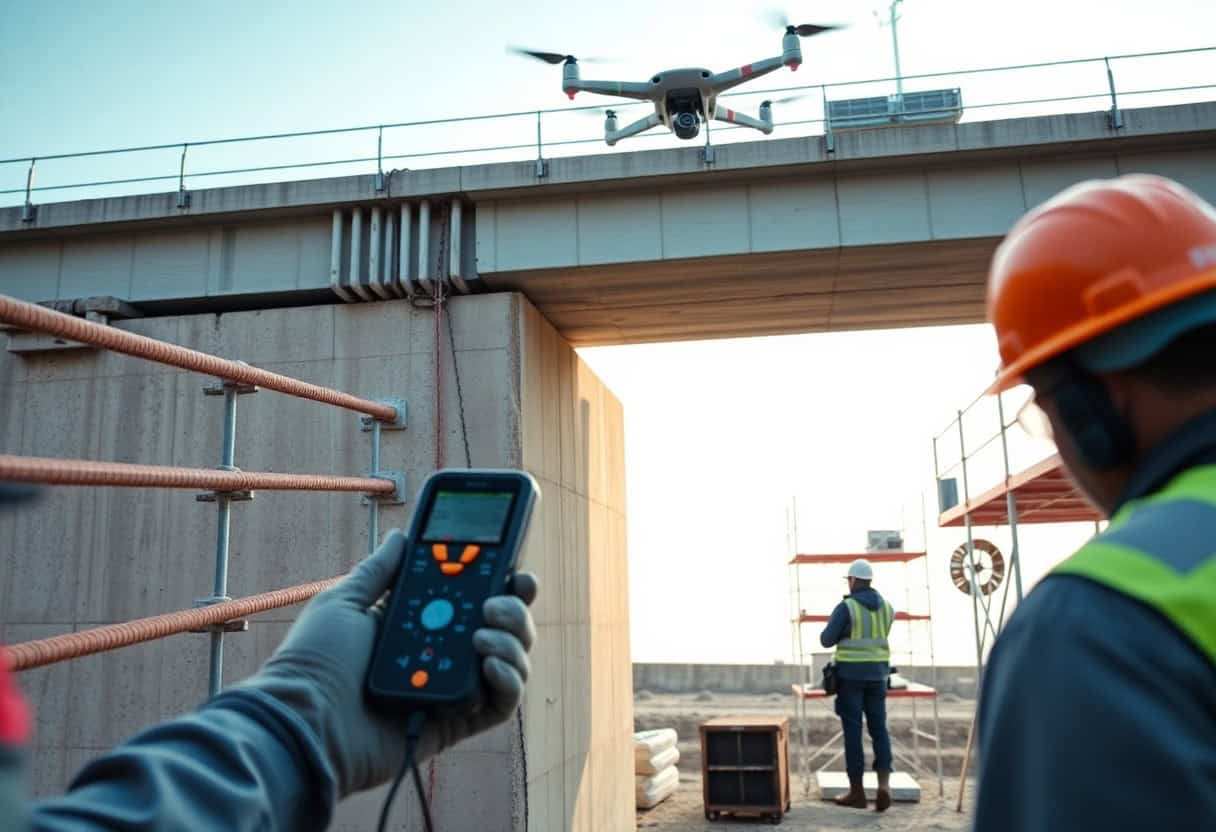
You should integrate continuous monitoring and periodic assessment to convert raw data into actionable maintenance that often reduces unplanned outages by 20-40%. Fibre‑optic sensing, accelerometer arrays and corrosion probes feed dashboards used on projects such as the Queensferry Crossing and Millau Viaduct, enabling you to spot drift in modal frequencies or a rise in chloride ingress rates and plan interventions before structural safety is compromised.
Structural health monitoring and instrumentation strategies
You must place sensors at critical load paths-midspan for spans, bearings, joints and abutments-and combine technologies: strain gauges for static loads, accelerometers for dynamic modal analysis (sampling 200-2,000 Hz during tests), and distributed fibre‑optic DTS/DAS for temperature and strain with ~1 m spatial resolution. Redundancy and remote calibration minimise data loss, while edge processing filters noise so your team sees only meaningful alarms.
Condition assessment, data analysis, and maintenance planning
You should complement SHM with targeted inspections and NDT (ultrasonic thickness, GPR, half‑cell potential) and feed results into analytics: trend analysis, Bayesian RUL models and supervised anomaly detectors. When models forecast increased failure probability or lifecycle cost rises, you schedule repairs using risk‑based intervals and integrate tasks into BIM for procurement and resource planning.
In practice, you begin with a baseline inspection post‑commissioning, establish alarm thresholds from Eurocode limits and historical patterns, then apply Kalman filtering and ML classifiers to separate transient events from progressive damage. A coastal bridge case often uses corrosion rate monitoring to time cathodic protection, extending service life by over a decade, and you quantify interventions with cost-benefit metrics to justify works before safety margins erode.
Asset Management, Lifecycle Costing, and Standards
When you plan for whole-life performance, you must account that operation and maintenance often represent 60-80% of lifecycle costs, so lifecycle costing and ISO 55000-based asset strategies drive decisions. Use data-driven maintenance plans and link to guidance such as Enduring Structures: Maintenance & Durability to optimise interventions, extend service life, and reduce unplanned outages through condition monitoring and targeted renewals.
Risk-based asset management and prioritization
You should apply risk matrices (1-5 scoring) that combine consequence and probability to prioritise works; assets scoring >3 get increased inspection frequency and earlier intervention. For example, transport authorities move bridges from annual to quarterly inspections when condition indices exceed thresholds, cutting failure probability and optimising budgets. Integrate remaining useful life estimates and probabilistic models so your investments yield the greatest resilience per pound spent.
Codes, standards, and regulatory frameworks for long-term performance
You must design and specify to recognised frameworks: ISO 55000 for asset management, Eurocodes and BS EN standards for structural design, and national Building Regulations for safety and durability. Typical service-life targets vary – 60 years for buildings, up to 120 years for major infrastructure – and standards set safety factors, exposure classes and material requirements that determine inspection intervals, maintenance strategies and procurement clauses.
In practice, you translate standards into technical clauses: specify minimum concrete cover (e.g., 30-50 mm per BS EN 1992-1-1), corrosion allowances, protective coatings, or cathodic protection for marine structures. Performance-based contracts can mandate availability targets (e.g., 99.5%) and lifecycle penalties, so your procurement, inspection regimes and asset registers must align with both prescriptive and performance requirements to avoid costly retrofit and legal exposure.
Resilience, Adaptation, and Case Studies
When you embed resilience and adaptation into design and asset management, you shift outcomes from reactive repair to measured longevity; the examples below show how targeted interventions, monitoring and policy changes delivered quantifiable reductions in failure, downtime and long‑term cost.
- Millennium Bridge (London) – opened 2000, wobble remediated with 37 viscous dampers installed in 2002; retrofit restored pedestrian safety within two years and prevented ongoing service interruptions.
- San Francisco-Oakland Bay Bridge (eastern span) – replacement completed 2013 at ~$6.4 billion; new span meets modern seismic standards and dramatically reduced collapse risk for daily traffic of ~280,000 vehicles.
- Delta Works (Netherlands) – phased system providing up to 1-in-10,000‑year storm protection for key areas, reducing flood exposure for several million residents and agricultural hectares.
Designing for climate change, extreme events, and adaptability
You must design to anticipated shifts in hazard intensity, so specify adaptive capacity, modular upgrades and monitoring; for example, raising critical thresholds and using service‑able subassemblies can reduce retrofit costs by a large margin and keep infrastructure operational through increased storm frequency.
Case studies, lessons learned, and best-practice transfer
You should analyse project metrics to extract transferrable fixes: detailed post‑project monitoring, cost‑benefit of retrofits and performance under stress reveal which lessons scale and which are site‑specific, enabling targeted policy and design updates.
- Millennium Bridge metrics – 37 dampers, closure period ~8 months, retrofit cost borne by authorities vs avoided liability and reputational damage.
- Bay Bridge metrics – replacement cost ~$6.4bn, design life >100 years, daily traffic resilience improved for ~280,000 vehicles.
- Delta Works outcomes – phased investment over decades, measurable reduction in flood probability for protected zones and avoided economic losses in the billions (EUR) over time.
You can accelerate best‑practice transfer by documenting performance indicators, publishing monitoring datasets and standardising retrofit packages; when you compare cost per life‑year saved, retrofit packages and new builds, the data guides prioritisation and regulatory change.
- Performance indicators – monitor downtime, repair frequency and residual life to rank interventions by cost‑effectiveness.
- Data sharing – open datasets from major projects enabled faster adoption of dampers, isolators and sacrificial layers across regions.
- Prioritisation metric – use expected annual damage reduction and life‑cycle cost to decide whether to retrofit or replace (examples above show retrofit often saves >50% of replacement spend in early interventions).
Conclusion
With these considerations, you make design choices, material selections and maintenance regimes that prolong your structure’s service life, reduce whole-life costs and protect occupant safety; by using monitoring, performance-based standards and timely refurbishment you sustain resilience and function across decades.