With rigorous site analysis and hydrological modelling, you can design drainage systems that mitigate flood risk and prevent structural damage, ensuring long-term resilience; by selecting appropriate materials, slopes and sustainable urban drainage measures you reduce maintenance costs and protect communities from erosion and subsidence, while meeting regulatory standards and adapting your design to climate variability.
Site Assessment & Hydrology
When you assess the site, map catchments, flow paths and connectivity, and consult local IDF curves; see How Engineering Solutions Ensure Proper Drainage Away from Your Residenc. Use gauged records and high-resolution DEMs to locate flood-prone corridors, estimate peak flows and note where urbanisation has raised runoff coefficients from ~0.2 to 0.9, greatly increasing peak discharge.
Topography, soils and groundwater conditions
Survey slope, aspect and microtopography with LiDAR or a DEM because a 1:20 slope can triple overland velocity versus 1:100; you should log depressions and flow concentration points. Perform percolation and permeability tests: sandy soils >10 mm/hr, silty clay <1 mm/hr. If groundwater lies within 1 m of the surface, you must expect reduced infiltration, perched water and possible lateral seepage into structures.
Rainfall, runoff analysis and design storm selection
Choose design storms by asset risk-residential systems often use 1-in-30-year, roads 1-in-100-year and critical infrastructure 1-in-200-year events-using local IDF curves. For small catchments (<1 ha) apply the rational method Q=CiA; for larger or heterogeneous basins use SCS-CN or continuous simulation. Include a climate allowance of +20-40% where guidance indicates increased intensity.
Develop hyetographs for relevant durations (5, 15, 60, 360 minutes) and run unit hydrograph or continuous models (SWMM, HEC-HMS) calibrated to historical events-one UK study showed a 1-in-100 event delivering ~85 mm over 6 hours that overwhelmed pre-existing drains. Use realistic CN or runoff coefficients (paved 0.85-0.95; grass 0.20-0.35), test antecedent moisture conditions and report sensitivity to climate projections to ensure your design maintains required freeboard under future scenarios.
Design Principles & Performance Criteria
You must balance capacity, resilience and maintenance when setting performance criteria, using return periods (1 in 30 to 1 in 100 years) and freeboard for critical assets; consult detailed advice such as The Secret to Successful Drainage Design? It’s All in … and verify assumptions with observed storm events and sensitivity testing.
Capacity, safety factors and serviceability
You size networks to carry design flows with margin for uncertainty and maintain service under surcharge scenarios.
- Capacity
- Safety factor
- Serviceability
Apply factors of around 1.2-1.5 where hydraulic uncertainty exists and allow freeboard or surcharge where overtopping would be dangerous. Recognizing you must document assumptions, inspection regimes and maintenance access to preserve long-term performance.
Hydraulic modeling, design standards and software tools
You should adopt 1D/2D modelling approaches aligned with CIRIA C753, BS EN 752 and ‘Sewers for Adoption’, testing scenarios such as 1:30 for surface water and 1:100 for critical routes with climate uplifts of 20-40% where applicable. Use validated tools like EPA SWMM, HEC-RAS, InfoWorks ICM and MicroDrainage for network and floodplain analysis, and verify outputs against recorded events.
Calibrate models with local rainfall (FEH13 or UKCP18 outputs), set Manning’s n from site surveys (typical 0.013-0.035 for pipes) and run sensitivity tests on roughness, inflows and blockage; for urban pluvial risk, deploy coupled 1D/2D grids at 2-5 m resolution to capture overland flow-case studies show missed overtopping and manhole surcharge when 2D detail is omitted, so you must verify designs against historic floods and report residual risk.
Once the design is fully completed by the structural or civil engineer and all performance criteria are confirmed, you can then undertake a structured value engineering review. This may include offering alternative compatible products, pipe materials, chamber systems or attenuation solutions that maintain full compliance with hydraulic and regulatory requirements while delivering best value to the client. Any substitutions must be technically equivalent or superior, documented, and approved in accordance with design change control procedures.
Surface Drainage Solutions
Road, urban and landscape surface drainage (gutters, swales, channels)
You design kerb-and-gutter systems with longitudinal gradients typically 0.5-2.0% to avoid ponding; swales often use side slopes no steeper than 3:1 and widths of 1-3 m to provide storage and infiltration. Channels lined with concrete or stone use Manning’s n ≈0.013-0.018 to size capacity for a 1-in-30 or 1-in-100-year storm. Blockage from sediment and leaves is the most common failure, so you must specify gratings and inspection intervals to protect flow and highway safety.
Detention, retention and conveyance strategies
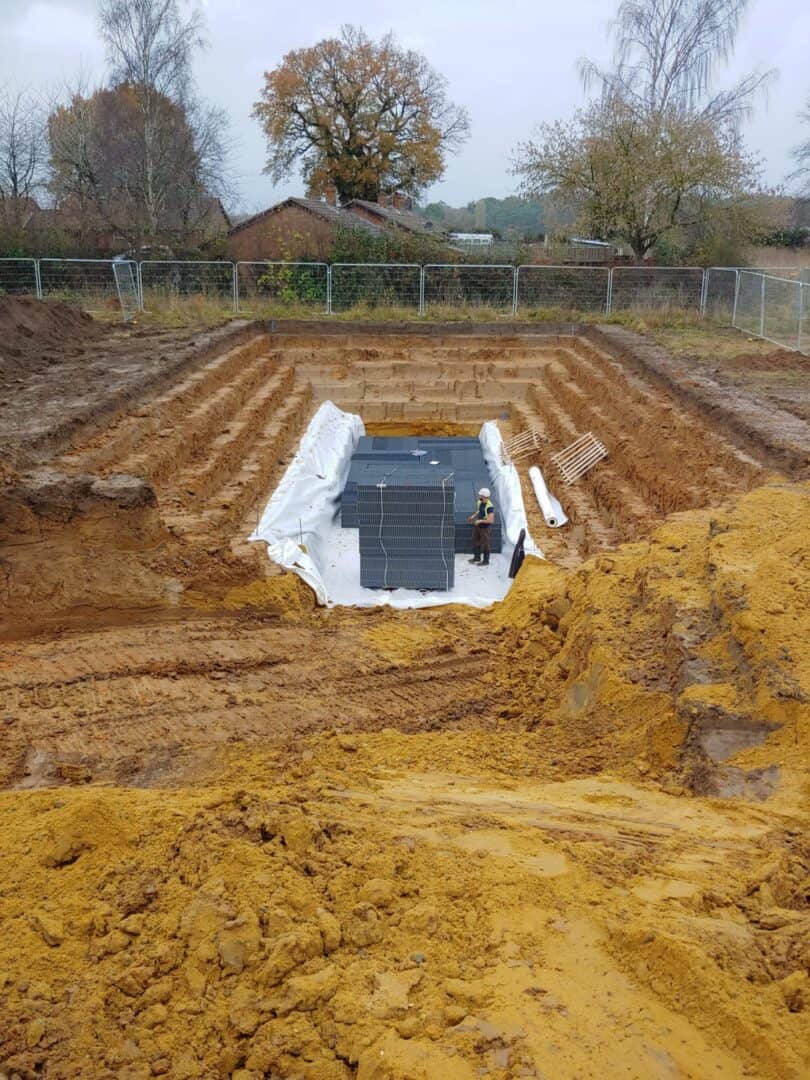
You size detention basins to attenuate peak flows for the design storm-commonly the 1-in-30 or 1-in-100-year event-with outflows controlled by orifices, hydrobrakes or spillways. Retention ponds hold a permanent pool to improve water quality and biodiversity. Conveyance uses pipes, culverts and swales sized using hydrograph methods (SCS/NRCS or FEH) and Manning’s equation; include emergency overflow capacity and a climate-change allowance (often up to 40% for peak rainfall) to prevent overtopping and downstream flooding.
Go deeper: detention basins are typically dry between storms and are routed so post-development peak discharge matches the agreed greenfield rate, whereas retention ponds maintain a permanent pool for sedimentation and ecology. For conveyance, adopt Manning’s n ≈0.013 for concrete and ≈0.025 for grassed channels, and ensure velocities exceed 0.6-0.8 m/s to avoid deposition while staying below erosion limits (commonly <2.0 m/s for soil linings). Use hydrograph routing or models (SWMM, InfoWorks) to define outlet orifice diameters and provide a minimum 300-500 mm freeboard plus an emergency spillway sized for the 1-in-100-year plus climate-change event; specify silt traps, access points and inspection regimes because inadequate maintenance is the main cause of long-term failure.
Subsurface Drainage & Groundwater Control
When managing the phreatic surface you must integrate subsurface drains, relief wells and cut-off walls to limit uplift and pore pressures; target lowering the water table by 0.5-2.0 metres for typical foundation works. Use Darcy’s law and transmissivity estimates (e.g. 1×10^-4-1×10^-3 m^2/s in coarse sands) to size systems, and install monitoring wells every 20-50 m to verify performance and avoid inadvertent settlement or slope failure.
French drains, perforated conduits and drainage layers
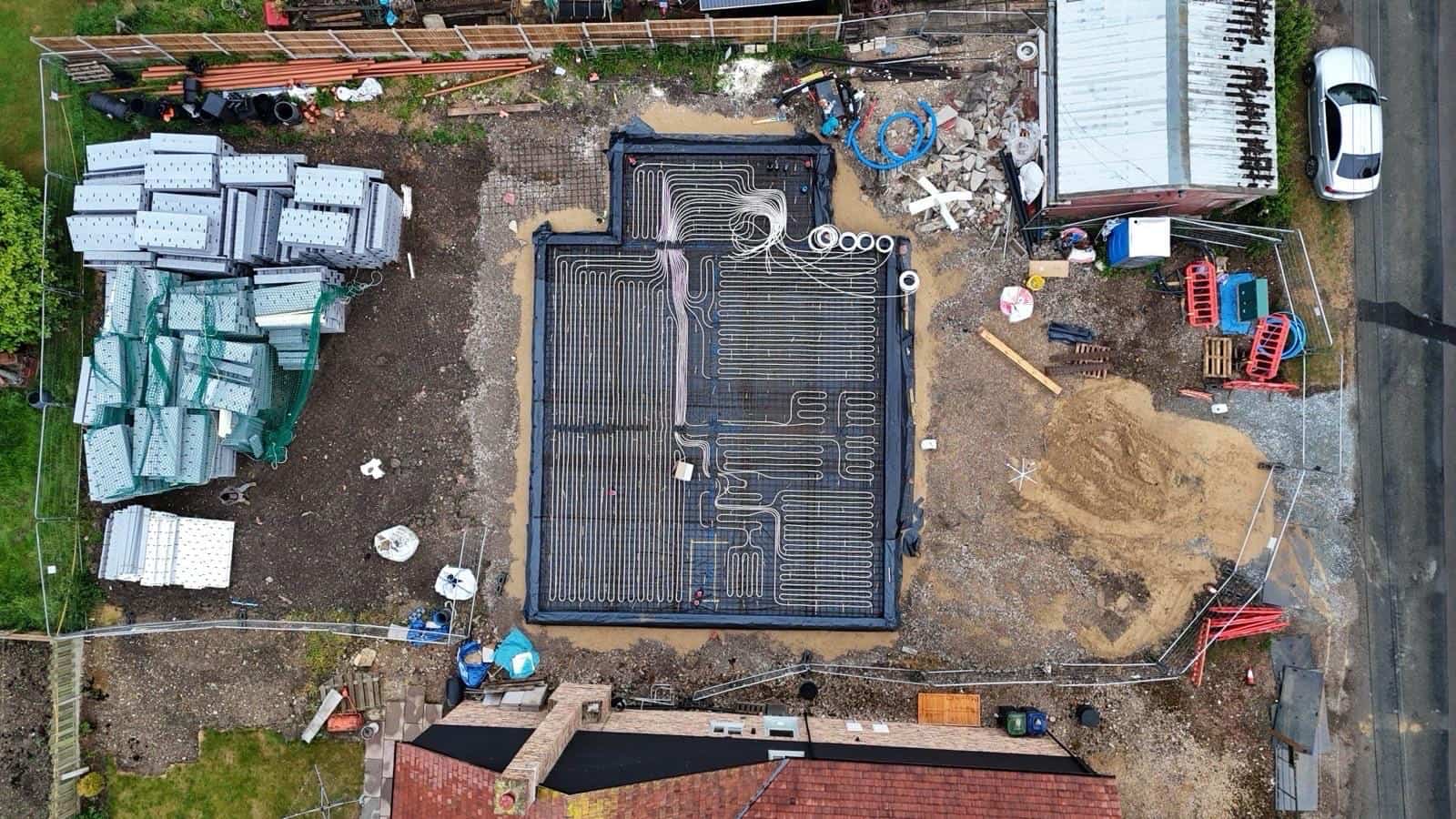
Use 75-150 mm perforated pipe bedded in 10-40 mm graded aggregate within a 300-600 mm trench, with a minimum slope of 1% and a non-woven geotextile to prevent fines ingress. You should space laterals by soil type-typically 5-20 m in silty sands and up to 30 m in clean sand-and provide inspection chambers every 10-20 m for flushing and CCTV checks to avoid long-term clogging and performance loss.
Dewatering methods, interceptor drains and seepage control
Wellpoints (effective to 4-6 m), deep wells (>6 m) and vacuum-assisted systems suit different depths and inflow regimes; a deep well can yield tens of litres per second in permeable strata. Interceptor drains and cutoff trenches capture lateral flow, while grout curtains and sheet piles reduce underseepage. You must control drawdown rates to protect adjacent structures because uncontrolled pumping risks subsidence and foundation damage.
Begin with baseline piezometer readings, then stage pumping and monitor continuously-limit drawdown to 0.5-1.0 metre per day near sensitive assets. In a 300 m excavation a wellpoint array of ~40 points produced a 1.8 m drawdown at ≈20 L/s total; you can reduce pumped volumes by combining toe interceptor drains, size sumps at 1.25× peak inflow, and ensure groundwater is treated to consent standards before discharge.
Materials, Construction Practices & Quality Control
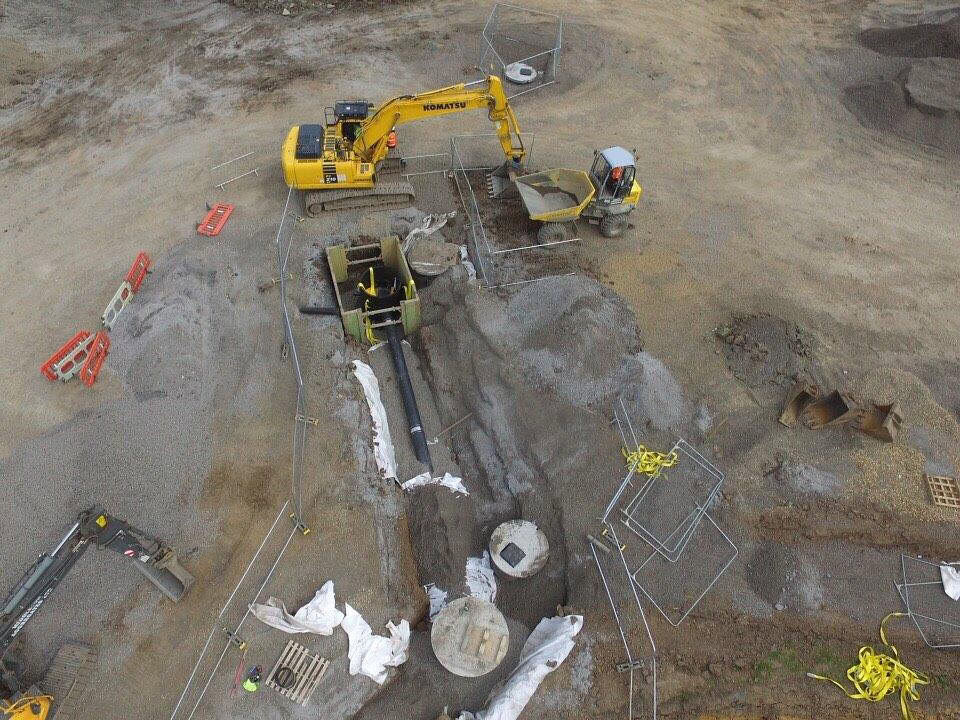
You should specify materials and practices that deliver longevity and maintainability: select pipes and manholes with expected lifetimes of 50-100 years, choose liners where chemical exposure demands, and enforce bedding, backfill and slope tolerances from the drawings. Ensure compaction to specified densities to avoid settlement and misalignment. Pay particular attention to filter compatibility and installation sequencing since poor compaction or mismatched filters can cause early failure.
Material selection, durability and installation details
You must define aggregate gradings such as clean 20-40 mm crushed stone for transmissive layers and require geotextiles with suitable apparent opening size (AOS) and permittivity. Specify non-woven for filtration, woven for separation, and HDPE liners welded and pressure-tested where chemical resistance is needed. Install geotextile overlaps of 300-600 mm and provide minimum 150 mm compacted bedding beneath pipes at 95% Standard Proctor to reduce settlement risk.
Inspection, testing and construction QA/QC
You should implement staged inspections: verify delivery certificates and perform sieve analysis, permeability and CBR tests on materials; carry out compaction testing to 95% Standard Proctor with a typical frequency of one density test per 200 m² or per 50 m of trench. Use CCTV and low-pressure air or water tests on completed pipes, log non-conformances, and ensure corrective actions are tracked. Inadequate QA leads to settlement, blockages and costly remediation.
You must demand specific test methods and acceptance criteria in your contract: falling-head permeability for filters, AOS and tensile strength for geotextiles, and weld/bond tests for liners. Define hold points at trench excavation, pipe laying, jointing and backfilling, require an independent inspector to sign off each stage, and ensure records, certificates and CCTV footage are retained for design-life audits; sample sizes should follow ISO or equivalent standards and the project risk profile.
Sustainability, Resilience & Regulatory Considerations
You must balance performance with policy and long-term resilience: integrate SuDS, runoff storage and conveyance to meet civil standards and climate allowances, and consult guidance such as Three Things to Consider When It Comes to Stormwater Design. Use models calibrated to local FEH/IDF data, apply a climate uplift (commonly +20-40% for peak intensity), and document sensitivity analyses for permitting.
Sustainable drainage systems (SuDS/Green Infrastructure) and climate resilience
You should implement permeable pavements, bioretention, swales and green roofs in a management-train to reduce runoff and improve water quality; for example, green roofs can retain ~40-60% of annual rainfall while bioretention basins commonly cut peak flows by 30-60% depending on soil and depth. Prioritise retrofit opportunities in high-impact catchments and size to the 1-in-30 and 1-in-100 events with climate uplift.
Codes, permitting, lifecycle costs and stakeholder coordination
You need to design to local codes (e.g. national planning guidance, EA or SEPA policies), allow for statutory drainage adoption, and budget for operation and maintenance-typically 2-5% of capital cost per year. Anticipate that non-compliance can delay projects by months, so lodge pre-application enquiries early and include agreements with utilities, highways and environmental regulators.
Further detail: you should run a two-stage consenting strategy-pre-application meeting within the first 8-12 weeks, submission with calibrated catchment modelling (FEH/NRCS), and a 30-year whole-life cost appraisal including 20-40% climate contingency. Document maintenance schedules, responsible parties, and monitoring metrics (e.g. annual peak flow reduction, pollutant load reduction) to satisfy adoption and funding bodies.
Final Words
From above, when you design drainage systems for civil engineering projects, you must assess site hydrology, soil conditions and long-term climate projections, apply sound hydraulic calculations and select resilient materials and components that simplify maintenance; incorporate sustainable urban drainage principles, ensure regulatory compliance and document performance criteria so your solutions manage runoff, mitigate flooding risk and provide reliable, cost-effective service throughout the asset lifecycle — and once fully designed, you can review the scheme for value engineering opportunities that maintain compliance while delivering the most efficient and commercially effective outcome for the client.