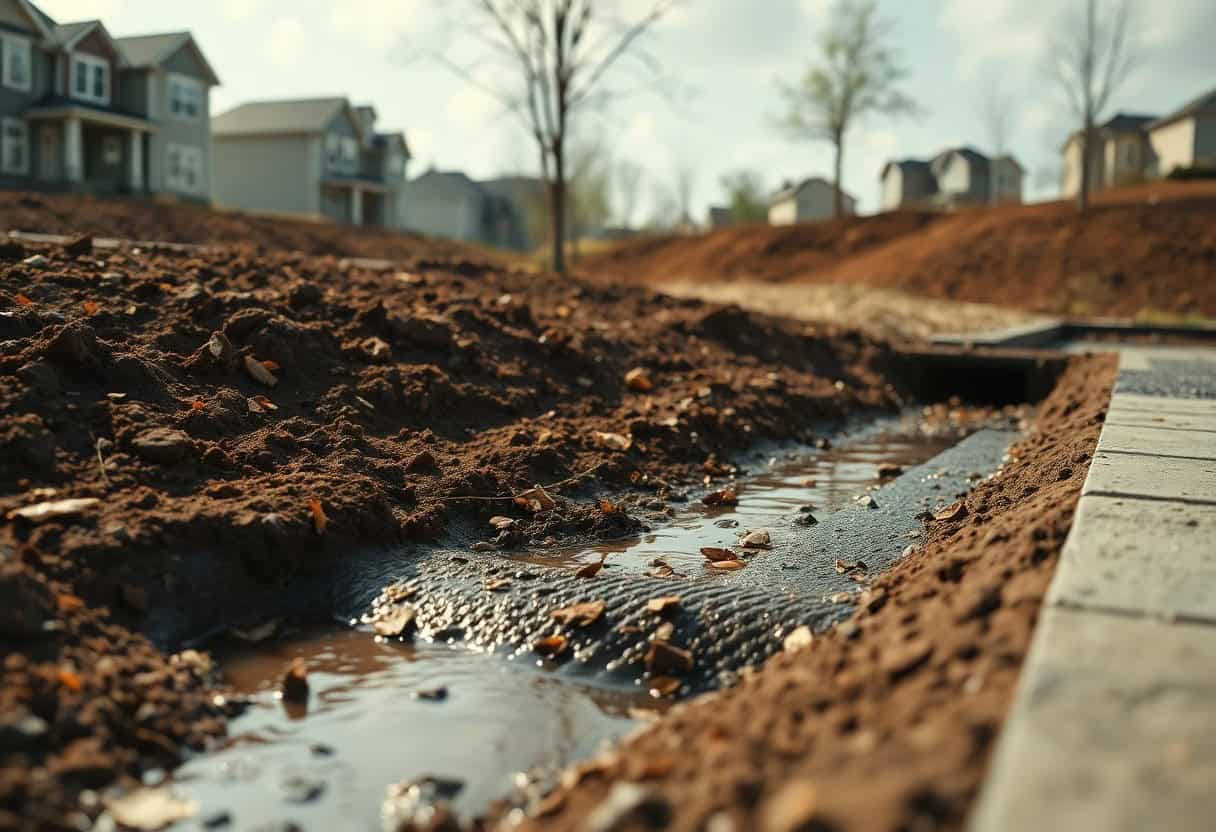
You must assess drainage early on to avoid problems such as flooding, siltation and blocked drains, and reduced infiltration from soil compaction; you should design positive outfalls, install adequate SUDS, and schedule regular inspections and maintenance to protect foundations, public safety and legal compliance while keeping your site operational and cost-effective.
Key Takeaways:
- Carry out early site assessment and design: survey topography and soil, model surface and groundwater flow, and incorporate SuDS (swales, retention basins, permeable paving) with appropriate gradients to manage runoff.
- Ensure correct construction and materials: install pipes, chambers and geotextiles to specification, provide access points and oversize conveyance where needed, and enforce quality control during earthworks to prevent settlement and misalignments.
- Plan for long‑term operation and coordination: implement a maintenance regime for clearing silt and debris, stabilise slopes and temporary erosion controls during works, and liaise with local drainage authorities to avoid overloading public networks.
Understanding Common Drainage Issues
You will face a mix of surface water, groundwater intrusion and blocked infrastructure on many developments; surface runoff can rise by 2-6× after urbanisation, amplifying flood risk and siltation. Often you see ponding on low-lying parcels, basement dampness and prematurely fouled culverts within months of construction. Pay attention to soil type, existing culverts and nearby watercourses, since those factors determine whether you need attenuation, infiltration or conveyance solutions to avert long-term damage.
Causes of Drainage Problems
Poor site preparation and design frequently trigger failures: soil compaction from machinery, over 50% impermeable cover from roads and roofs, and incorrect fall details all reduce infiltration. Legacy assets-old culverts, collapsed pipes or misconnections-add silt and blockages, while overloaded sewers during intense storms create surcharge. You should also account for seasonal high groundwater and clay soils that give very low permeability, forcing surface discharge strategies instead of infiltration.
Identifying Drainage Issues on Development Sites
You should routinely inspect for signs such as persistent ponding beyond 24 hours, soft or cracked carriageways, staining and silty outfalls, and recurring basement damp. Use simple checks-measure depth of standing water, note odours, and log when flooding follows rainfall of 10-30 mm-to prioritise investigations. Highlight any evidence of subsidence or contaminated runoff for immediate action, as these pose the greatest risk to safety and project costs.
For more detail, you must employ targeted investigations: CCTV surveys of drains, dye tests to trace misconnections, trial pits to expose pipe condition and percolation or infiltration testing to quantify rates. Combine these with topographic surveys and modelling for 1‑in‑30 and 1‑in‑100‑year events (including climate change allowances) so you can design attenuation volumes and SuDS sized to demonstrably prevent repeated failures.
How to Assess Site Drainage
When you assess drainage, combine a topographic survey, soil investigation and groundwater monitoring with hydraulic modelling to predict ponding, overland flow and subsoil seepage; consult resources such as Common Drainage Challenges of Commercial Properties for case studies, and focus on surface flooding and siltation hotspots identified by historical records.
- topography
- infiltration rate
- Any SuDS constraints and permit limits
Site Evaluation Techniques
You should use a mix of desk studies, walkover surveys, trial pits and infiltration testing (per BRE 365 methodology) alongside a detailed topographic survey or LiDAR; combine these with rainfall series analysis (1:30 and 1:100-year events) and hydraulic models such as MicroDrainage or SWMM to quantify flows and storage needs and to validate design of attenuation basins and permeable pavements.
Key Factors to Consider
Pay attention to soil type (clay vs sand), slope, groundwater depth, existing drainage assets and proximity to watercourses; include Environment Agency climate-change allowances (consult epoch-specific values) and assess legal discharge points to avoid exceedance of consented rates or causing off-site flooding.
For practical appraisal, you should prioritise infiltration testing (Permeability k-values), trial pits to observe strata and perched water, and CCTV of existing sewers to detect blockages and silt; quantify storage required (m3) using runoff coefficients for different surfaces and allow a safety margin for future intensification.
- infiltration testing
- trial pits
- Any CCTV sewer survey to confirm capacity
Tips for Effective Drainage Design
Integrate measures early so you avoid costly flooding and siltation: prioritise site grading, conveyance and on‑site storage.
- Grading to shed water from structures
- Swales/pipes sized for peak runoff
- Silt controls and detention to protect downstream
Refer to Addressing Drainage Issues in the Urban Landscape for practical examples. The guidance helps you quantify runoff and choose controls.
Incorporating Proper Grading
Set finished levels so water is shed from buildings and you prevent standing water: aim for a minimum fall of 1-2% (1:100-1:50) across yards and paved areas, with a 50-75mm drop within the first metre from foundations. Use laser‑levelled benches and trial pits to verify infiltration; maintain a 3‑metre buffer where possible. On one development a consistent 2% fall cut surface ponding by 85% within three months, reducing site safety risks and maintenance demands.
Selecting Appropriate Drainage Systems
You should match system type to site hydraulics: use permeable paving and attenuation basins for high runoff, and consider piped systems sized appropriately-commonly 150-225mm for on‑site collectors; design for peak flows using the rational method and a chosen return period (1‑in‑30 to 1‑in‑100 years). Prioritise SUDS elements to reduce flow and improve quality, and always model flows to avoid undersized pipes that cause surcharge.
Consider hydraulics and maintenance when selecting systems: size conveyance for the 1‑in‑100‑year event plus a climate allowance of 30-40% and provide safe exceedance routes; specify inspection chambers and access so you can inspect every 50-100 metres and programme desilting (sediment traps annually, permeable paving vacuumed every 1-3 years). Choose materials (HDPE, concrete) based on loads and abrasion; adding forebays and modest increases in attenuation volume has reduced downstream peaks by 30-40% in scheme audits.
Best Practices for Site Preparation
You must set finished ground levels and temporary drainage before heavy works start: provide a positive fall of at least 1:100 (1%) away from buildings, protect adjacent land with perimeter channels, and retain topsoil 150-300mm for reuse. Stage earthworks to limit exposed soil to under 14 days where possible, plan haul routes to prevent tracking, and sequence drainage installation so surface water is controlled from day one.
Soil and Vegetation Management
You should protect topsoil and vegetation to preserve infiltration and soil structure: strip and stockpile topsoil separately and respread within the top 150-300mm. On slopes steeper than 1:6 use seed with erosion matting or hydroseeding, and avoid plant movement when soil moisture exceeds 85% of optimum to prevent compaction that dramatically reduces infiltration. Establish vegetative buffers of 3-10m to intercept runoff and sediment.
Temporary vs. Permanent Solutions
You must distinguish temporary measures-silt fences, sandbags, site bunds and diversion channels-from permanent installations such as swales, piped drainage and attenuation ponds sized for the design storm (for example a 1-in-100-year event). Deploy temporaries immediately; failure to maintain them is the most common cause of on-site flooding. Only remove temporaries once permanent systems are commissioned and functioning as designed.
You should inspect temporary controls at least weekly and within 24 hours after any rainfall over 10mm, because silt fences and check dams clog quickly; well-maintained silt fences can reduce sediment loss by up to 80% in low-flow conditions. For permanents, design for a 1-in-100-year event with a climate change allowance of +20-40%, plan for 30-60 year service lives, and include commissioning tests and a maintenance schedule in your programme.
Preventive Measures During Construction
You should phase earthworks to minimise exposed soil, install temporary diversion drains and settle ponds immediately after strip‑out, and grade surfaces to shed water away from excavations. Implement temporary culverts and lined channels where necessary, and ensure exposed slopes are stabilised within seven days to prevent failures; untreated runoff from a single heavy storm can mobilise thousands of tonnes of sediment on larger sites, so rapid containment limits costly reinstatement and health‑and‑safety hazards.
Erosion Control Strategies
Use a combination of silt fences, sediment basins, wattles and hydroseeding within seven days to rapidly restore surface cover; silt fences placed at the toe of slopes and along drainage lines can reduce sediment transport by up to 80% when properly entrenched and keyed. On slopes steeper than 15% use geotextile blankets or erosion control matting, and size sediment traps to capture the first flush from the catchment area.
Regular Site Maintenance Practices
Carry out inspections weekly and within 24 hours after any rainfall over 10 mm, clear debris from channels, service pumps and repair eroded berms within 48 hours; blocked drains create flood risk and structural damage if left unattended. Keep a digital log of actions with photos and timestamps so you can demonstrate compliance and accelerate contractor accountability.
Further detail: adopt a written maintenance schedule that specifies checks (silt fences, sediment basins, inlet grates), empty basins when they reach roughly 50% sediment capacity, replace torn geotextile immediately and test temporary pumps monthly. Assign responsibility to named personnel, map all drainage assets on site plans, and use a simple checklist to ensure consistent execution-this approach reduces repeated failures and keeps remedial costs down.
Long-term Drainage Solutions
Adopt a lifecycle approach that sizes attenuation and storage for a 1-in-100-year event plus 40% climate change allowance, specifies component service lives of 30-60 years and allocates clear maintenance responsibility. You should link design models to a maintenance schedule, plan for silt removal and access points, and factor soil infiltration (e.g. >0.5 m/day for soakaways) so that long-term performance is not undermined by blocked outfalls or progressive compaction.
Implementing Sustainable Drainage Systems
Combine swales, infiltration trenches, permeable paving and attenuation ponds so you reduce peak runoff and improve water quality: permeable pavements can cut surface runoff by up to 50-70%, while bioretention areas commonly remove 80-90% of suspended solids. You must size storage volumes to match site-specific rainfall intensity and soil tests, provide access for desludging, and include an operations plan detailing inspection intervals and sediment management.
Monitoring and Adjusting Post-Construction
Set up a monitoring regime with visual inspections, periodic CCTV of pipework and, where justified, flow meters or level sensors; inspect SuDS quarterly for the first two years and then biannually, logging performance against design targets. You should use early monitoring results to tweak outlet controls, raise storage capacity or add pre-treatment if measured discharge or water quality fails to meet limits.
Define clear KPIs – peak discharge, time-to-peak, ponding depth and infiltration rate – and set thresholds that trigger action (for example, when silt accumulation exceeds 10% of storage volume). Use telemetry for real-time alerts, compare monitoring data to your original hydrological model, and implement corrective measures such as additional storage, increased maintenance frequency or retrofitted permeable surfaces when targets are breached.
Summing up
The most effective approach is for you to carry out a thorough site assessment, design robust surface and subsurface systems (SUDS, attenuation, permeable paving), ensure correct grading and soil compaction, install adequate gullies and silt traps, and implement routine inspection and maintenance; by integrating drainage into your planning and construction you protect assets, comply with regulations and reduce long‑term costs.