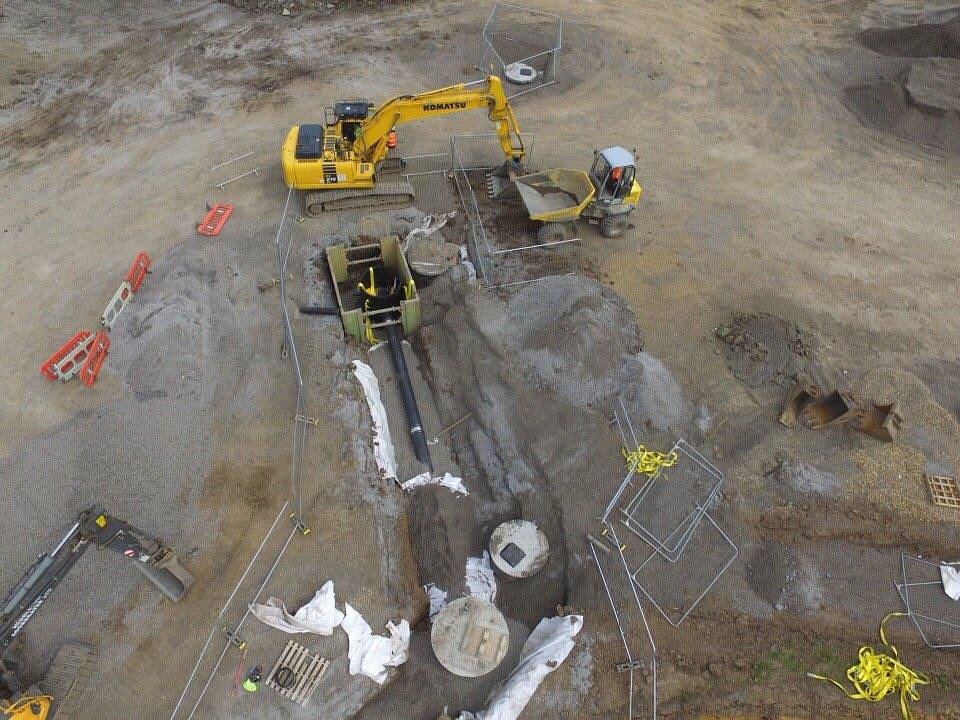
On a housing development, highways adoption rarely gets the commercial attention it deserves until it goes wrong. Roads and sewers built outside adoption standards, identified late, and requiring rectification before adoption can be granted hold up plot sales, residential occupation, and final development closeout. The cost of putting it right after the fact is significant. The cost of getting it right first time is largely the cost of the original work properly executed and properly documented.
What adoption involves
On most UK housing developments, the access roads, footpaths, and drainage infrastructure within the scheme are constructed by the developer to standards set by the local highways authority and the relevant water and sewerage undertaker. Once complete and inspected, this infrastructure is adopted by the public bodies — typically through section 38 agreements for highways and section 104 agreements for sewers — at which point it becomes the public body’s responsibility to maintain.
Until adoption is granted, the developer carries the maintenance liability and, in many cases, the bonded financial security. Plot sales can complete before adoption, but unadopted infrastructure is a known issue for buyers, conveyancers, and mortgage providers. Schemes where adoption is delayed or refused create a drag on the sales programme that can persist for years.
Where adoption usually goes wrong
Adoption issues rarely arise from grand failures. They arise from accumulated small deviations from the adoption specification — kerb levels that are slightly out of tolerance, channels that don’t quite drain to gully, sewer falls that approach but don’t meet the minimum gradient, manhole construction that varies from the standard detail. Each issue in isolation is minor. Together, on a scheme of any size, they produce an adoption snagging list that can take months to resolve.
The pattern is consistent. Where adoption goes wrong, the contractor delivering the works either did not fully understand the adoption specification at the outset or did not maintain consistent quality control through the work. Both are issues that can be controlled with the right contractor and the right management system in place.
How GCE delivers adoptable infrastructure
GCE delivers roads and sewers works to adoption standards across housing developments in East Anglia and the Southeast. The approach is built on three things: a working knowledge of local highways authority and water company adoption requirements, documented quality management procedures aligned to those requirements, and inspection and sign-off discipline through the work.
Each adoptable element — kerbs, channels, road build-up, sewer pipework, manholes, gullies, ironwork — is constructed to the documented specification and inspected against that specification before the next operation builds over it. Variations from specification are identified and resolved during the work, not deferred to the end-of-scheme adoption inspection. ISO 9001 certification across the Globe Group means these procedures are documented, audited, and applied consistently across phases and across years of programme delivery.
Documentation that supports adoption
Adoption inspections are document-driven. The local authority and water company will look for evidence that the work was carried out to specification, that the materials used were compliant, that pipework was tested and signed off, and that any deviations were identified and addressed. The documentation produced during construction is what supports this verification.
On schemes where GCE delivers section 38 and section 104 works, this documentation is produced as part of the standard quality management process. CCTV surveys of sewerage are recorded. Pressure tests are documented. Material certifications are filed. Inspection sign-offs are traceable to the supervisor and operative responsible. When the adoption inspection occurs, the documentation is ready and the inspection process is shorter.
The commercial impact on the sales programme
For a developer, the link between adoption and the sales programme is direct. Plots within an unadopted estate can sell, but they sell against a backdrop of conveyancing complications, ongoing maintenance liability, and bonded security against future remediation. Plots within an adopted estate sell cleanly. Faster adoption produces faster release of bonded security, faster handover of liability, and a cleaner final closeout for the development.
On larger developments releasing plots over years, the difference between schemes where adoption tracks the build programme and schemes where adoption lags significantly behind is measurable in commercial terms. The cost of getting roads and sewers right first time is small compared to the cost of carrying unadopted infrastructure across the closing stages of a scheme.
UK Power Networks and other utility coordination
Adoption is not the only external coordination required on roads and sewers works. Utility connections, including UK Power Networks for electrical infrastructure, run on their own timelines and inspection regimes. GCE’s accreditation with UK Power Networks supports the coordination of utility works alongside the adoptable infrastructure, reducing the risk of clashes or sequencing issues that can hold up adoption.
Talk to GCE about your scheme
To discuss highways adoption and roads and sewers delivery on your development, contact GCE on 01223 890727 or email enquiries@theglobegroup.co.uk.